 WeeklyTrail
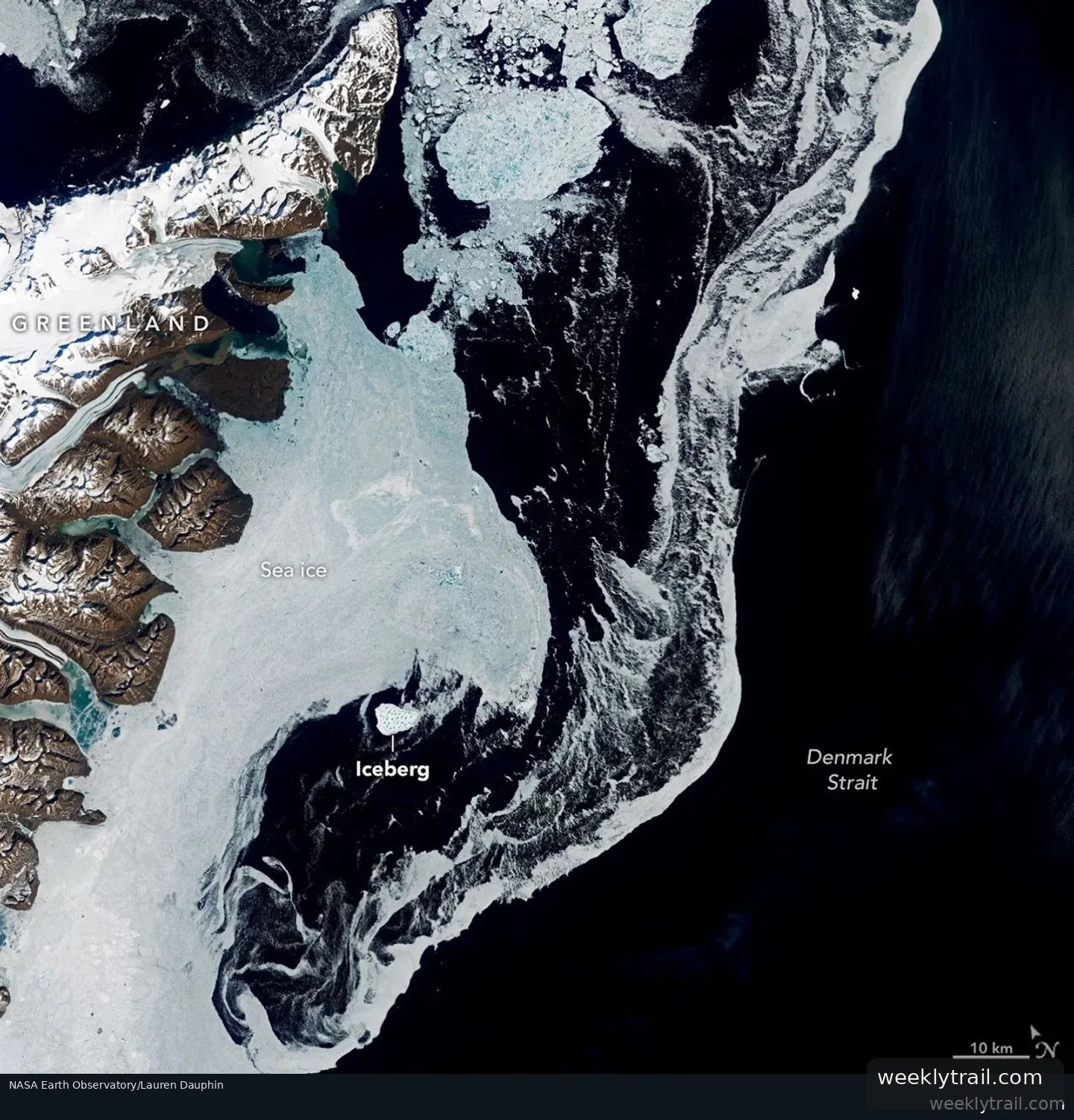
NASA Earth Observatory reported on August 20, 2026, that a large iceberg seen in summer 2026 had drifted more than 1,000 kilometers south from the northeastern Greenland bay where it likely originated. Satellite imagery from the Operational Land Imager on Landsat 9 captured the berg on June 12 in the Denmark Strait between Greenland and Iceland, amid a mixture of sea ice and berg fragments.
Measuring roughly 17 square kilometers (7 square miles) on June 12, the iceberg was about five times the area of Central Park, modest by Antarctic standards but large for Greenland. The Danish Meteorological Institute's Keld Quistgaard said it originated in Jøkelbugten, though its precise origin within the bay remains uncertain; it may have broken from Zachariæ Isstrøm or its adjacent remnant ice shelf. Retired glaciologist Christopher Shuman said its size and network of blue meltwater ponds resemble the remnant shelf ice.
As of mid-August, the berg was about 1,500 kilometers from the bay, drifting south on the Greenland Coastal Current. Quistgaard expected it to gradually disintegrate during that month, and recent imagery suggested it was doing so. Breaking up in the strait makes it unlikely that remnants would reach busier shipping lanes past southern Greenland.



Start the conversation. A good question is half the story.