 WeeklyTrail
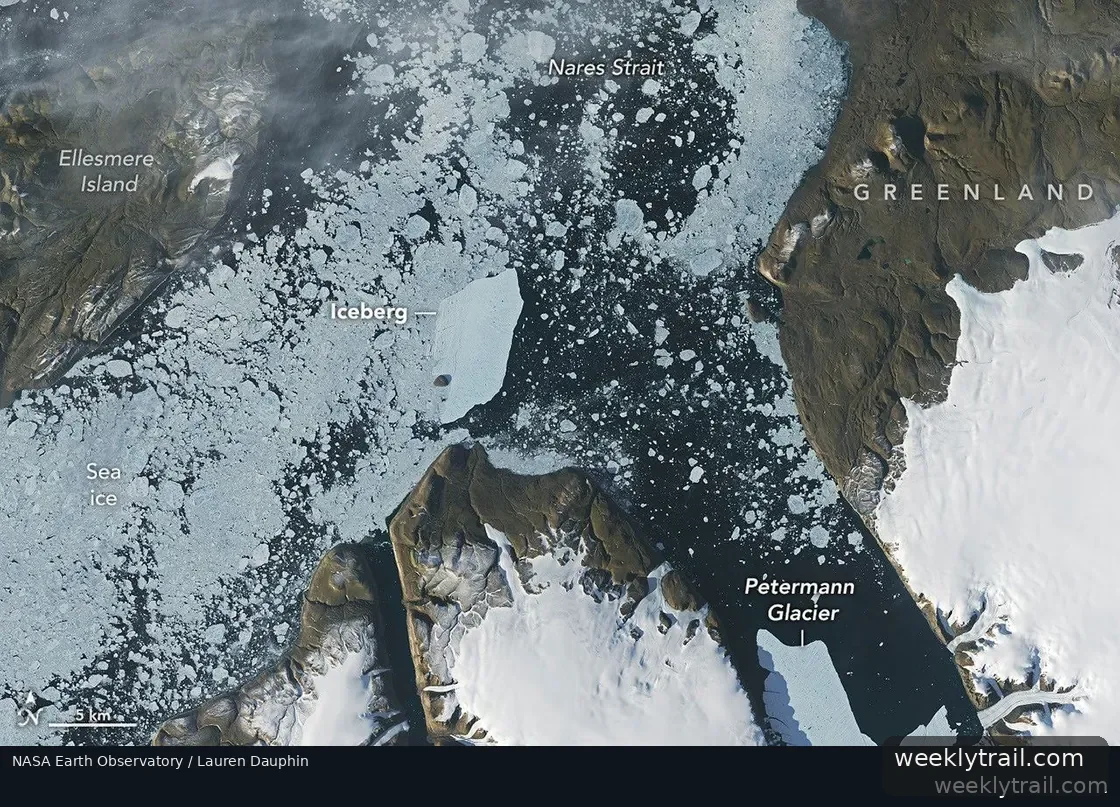
A large iceberg broke from Petermann Glacier in northwest Greenland in August 2026, and NASA Earth Observatory reported on September 1, 2026, that the berg had pivoted out of Petermann Fjord and continued southwest through Nares Strait after a brief collision with Joe Island. Landsat 9 images from August 23 and 24, 2026, show the encounter.
Adam Garbo, a doctoral student in glaciology at the University of Ottawa, spotted the calving on August 4 in Sentinel-1 imagery. Garbo and colleagues reported the tabular iceberg measured just over 76 square kilometers when it calved, the largest to break from the glacier since a 130-square-kilometer ice island in 2012. Garbo said the calving followed a different fracture than expected, producing a smaller ice island than anticipated.
As of late August, two large rifts remained and were expected to eventually yield ice islands of roughly 94 and 84 square kilometers, with timing uncertain. Glaciologist Mauri Pelto of Nichols College tracked the berg drifting an average of 3 kilometers per day in its first week. Garbo said the team was impressed the ice island survived its interaction with Joe Island without further fragmentation.
No comments yet.