


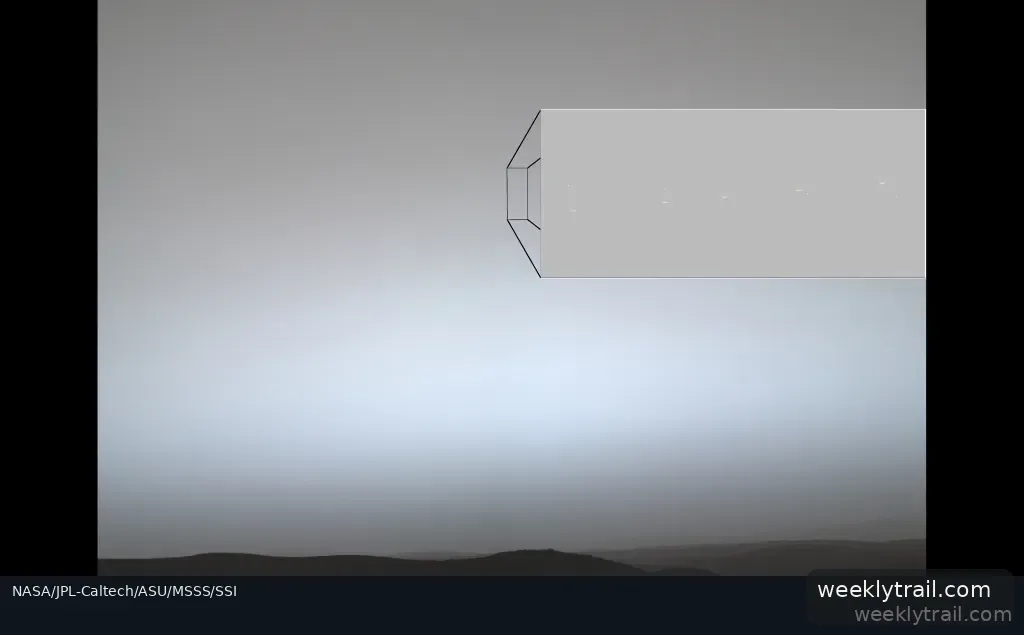
On July 2, 2026 — the 1,907th Martian day, or sol, of its mission — NASA's Perseverance rover used its Mastcam-Z instrument to capture Earth disappearing behind the Martian moon Phobos, NASA's Jet Propulsion Laboratory reported on Aug. 5, 2026. The agency described it as the first time humanity has observed Earth disappearing behind an object from another planet's surface.
The images, taken at about 7 p.m. local solar time, show Earth as a point of light moving from the upper left to the lower right while Phobos crossed from lower left to upper right. Phobos is about 17 miles (27 kilometers) across at its widest and orbits roughly 4,850 miles (7,800 kilometers) from Mars; at the time, it appeared about one-third the width of Earth's Moon as seen from Earth. Earth was about 195 million miles (314 million kilometers) away. Astronomers call the event an occultation, when a larger-appearing body completely blocks another from the viewer's standpoint.
Justin Maki of JPL, Mastcam-Z's deputy principal investigator, called the composite a unique Earth self-portrait with a "Phobos photobomb." Mark Lemmon of the Space Science Institute, who planned the observation and assembled the composite, said catching Phobos directly in front of Earth requires planning and some luck.




No comments yet.