 WeeklyTrail
ESA outlined its August eclipse broadcast and public-event plans
In an 11 August 2026 announcement, ESA described the predicted eclipse path for the following day and its planned broadcast and León event.

In an 11 August 2026 announcement, ESA described the predicted eclipse path for the following day and its planned broadcast and León event.
Copernicus Sentinel-2 images from early August 2026 reveal sharply lower water levels on the Danube near Budapest, as Hungary records a historic low driven by severe drought across central Europe.
Three NAVISP-backed projects are developing new ways to detect and map interference with satellite navigation, as reports of malicious disruption to ships rose sharply in 2025.

Astronomers say the treble clef-shaped radio formation is likely the result of an earlier supermassive black hole outburst followed by a collision between two galaxy clusters, according to a study published Wednesday.
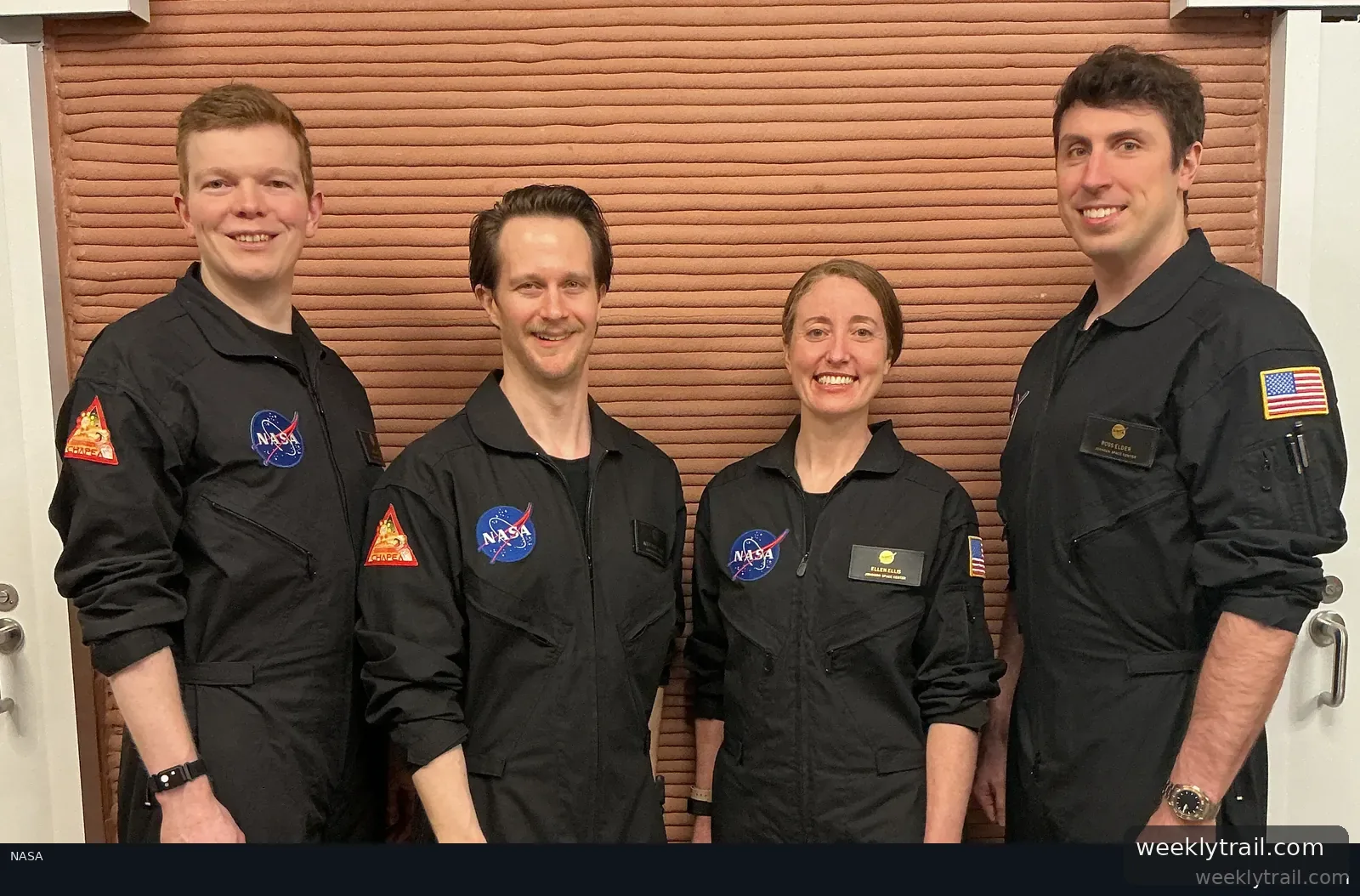
NASA’s 19 October 2026 update reported 365 days in isolation and described a planned 31 October exit from the simulated Mars habitat.
ESA’s CESAR team and Rubén García Benito of IAA-CSIC created a musical interpretation of the 12 August 2026 total solar eclipse as seen from the Observatorio Astrofísico de Javalambre in Spain. Nine parameters from a Stellarium simulation shape the sound.
The European Space Agency's image roundup for 10-14 August 2026 includes astronaut Sophie Adenot preparing for her first spacewalk, a Webb view of the Lion Nebula and a Proba-3 artificial solar eclipse.
Satellites tracked sharp rises in fire activity and smoke across the central and eastern Amazon from September 2026, with heavy smoke over Manaus on October 12 prompting school closures and event cancellations.
NASA's Astronomy Picture of the Day for October 16, 2026 features a timelapse by Eric Holland of a Falcon 9 and Dragon launch seen from Indian Harbour Beach, Florida.
ESA says its Proba-3 satellites captured the Moon crossing their field of view just hours before the 12 August 2026 total solar eclipse swept across parts of Europe, while the pair kept up their own artificial eclipse.
Using the James Webb Space Telescope, an international team of astronomers reports that dust and water can form and survive surprisingly close to Sagittarius A*, the supermassive black hole at the centre of the Milky Way.
NASA reported on Oct. 16, 2026, that five spacecraft were docked at the station following Dragon's arrival, while astronauts unloaded science supplies and prepared experiments and solar-array work.