 WeeklyTrail
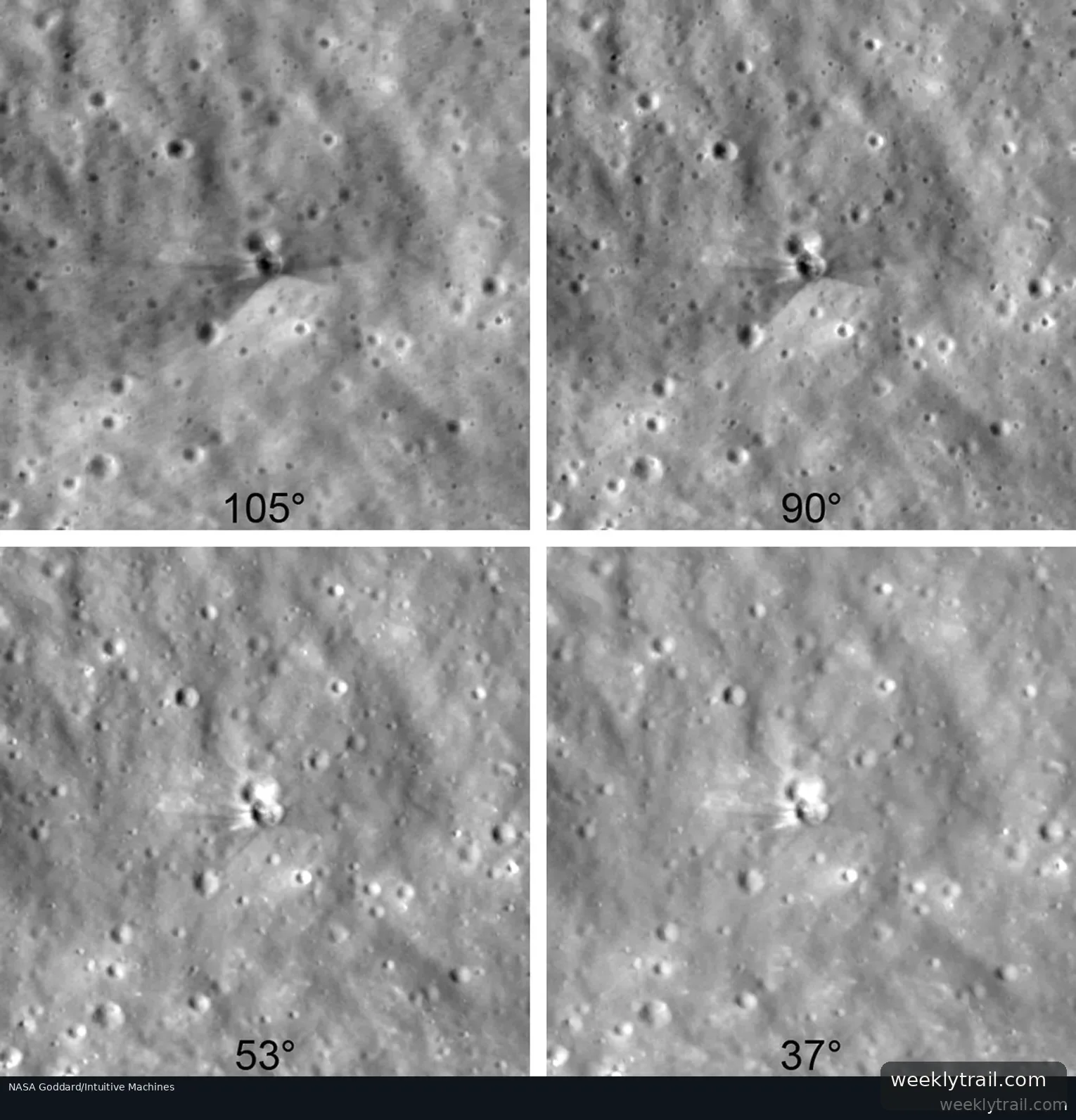
NASA reported on August 18, 2026 that its Lunar Reconnaissance Orbiter (LRO) captured images of a new crater on the Moon between August 11 and 12, 2026. The crater formed on August 5, 2026, when a SpaceX Falcon 9 upper stage struck the surface after its January 2025 launch of the Firefly Blue Ghost 1 mission. Engineers tilted the spacecraft so its cameras pointed at the crater as LRO passed about 60 miles above the Moon at 1 mile per second; the spacecraft had to wait six days for the location to rotate into view.
Using images in which the crater rim stood out, scientists measured a width of 60 feet, and estimated the crater is less than 10 feet deep from the length of its shadow. LRO’s Narrow-Angle Camera can spot features as small as 3 feet wide. Bright rays near the rim are fresh material excavated from deeper underground, while darker streaks are weathered surface material excavated from 1.5 feet down.
Independent astronomers first identified the rocket’s trajectory from public data. NASA’s Center for Near Earth Object Studies refined the prediction and passed it to the Republic of Korea’s Korea Pathfinder Lunar Orbiter (Danuri) team, which imaged the crater a few hours later; the prediction was accurate to about 0.6 miles. The LRO team updated the crater center coordinates to 19.4759°N, 266.7138°E, 511 meters elevation.


No comments yet.