 WeeklyTrail
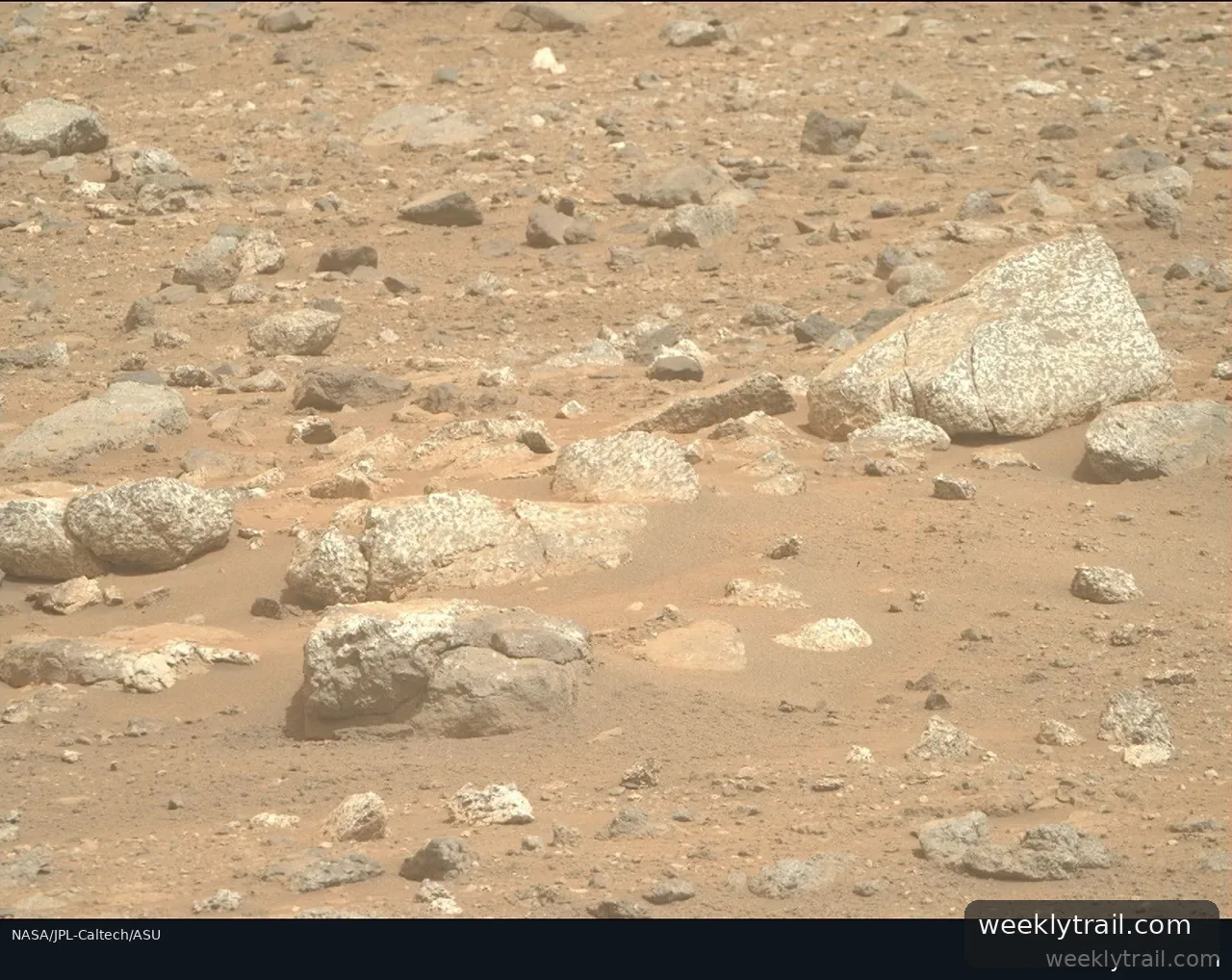
After six months exploring "Lac de Charmes," a region of ancient rock beyond the western rim of Jezero crater, NASA's Perseverance rover encountered a vast field of light-toned rocks, the mission team reported in a blog published Oct. 5, 2026. Light-colored rocks are unusual on Mars, a planet dominated by dark basaltic rocks, and the Science Team is investigating what the rocks are and how they reached the surface.
Data so far indicate many of the rocks are igneous gabbro, dominated by iron- and magnesium-rich minerals, which typically form by slow cooling and crystallization of magma deep in the crust. In the week before the post, the rover was examining a patch of possible bedrock between the boulders and loose regolith. Initial images suggest the rock consists of light- and dark-colored angular fragments, a breccia. One possibility under investigation is that the light-toned boulders eroded out of this breccia.
Breccias often form through violent processes that fracture and transport rock. Layers of breccia observed outside Jezero have previously been attributed to asteroid impacts on early Mars, and the team is considering whether similar impacts, or the Jezero impact itself, could have brought up these blocks. The team says only further investigation will settle the question.


Start the conversation. A good question is half the story.