 WeeklyTrail
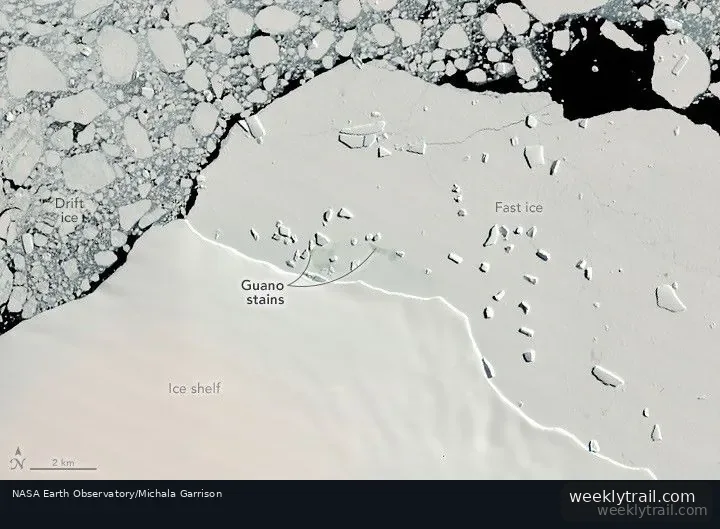
Two studies published in 2026 drew on decades of Landsat satellite observations to examine emperor penguin colonies around Antarctica, NASA Earth Observatory reported on August 26, 2026. Researchers identify colonies by the guano stains left where thousands of birds gather on landfast ice, a type of sea ice attached to the shoreline that the penguins use to breed, raise chicks and molt.
Researchers at the University of Freiburg found that 18 colonies predate their initial identification by an average of 17 years. The roughly 6,000-bird Smyley Island colony in the Bellingshausen Sea dates to at least 1989, two decades earlier than previously known. Scientists have watched that colony closely since it may have suffered a total breeding failure in 2022, when images showed birds splitting up and some moving onto a grounded iceberg. Despite persistently low sea-ice conditions, the colony has continued to appear, generally near icebergs along the ice-shelf edge.
A second study led by Grant Macdonald of Durham University analyzed nearly 40 years of observations for three colonies disrupted by iceberg calving or early sea-ice breakup. Penguins at the Mertz and SANAE colonies temporarily shifted to nearby icebergs, embayments or ice shelves before returning to former breeding sites. Macdonald described such moves as potentially a useful adaptation as sea ice declines, while cautioning that behavioral flexibility alone may not offset long-term sea-ice loss. The report notes that Antarctic sea ice has declined since 2016 and that models project emperor penguins could disappear by 2100.


Start the conversation. A good question is half the story.