 WeeklyTrail
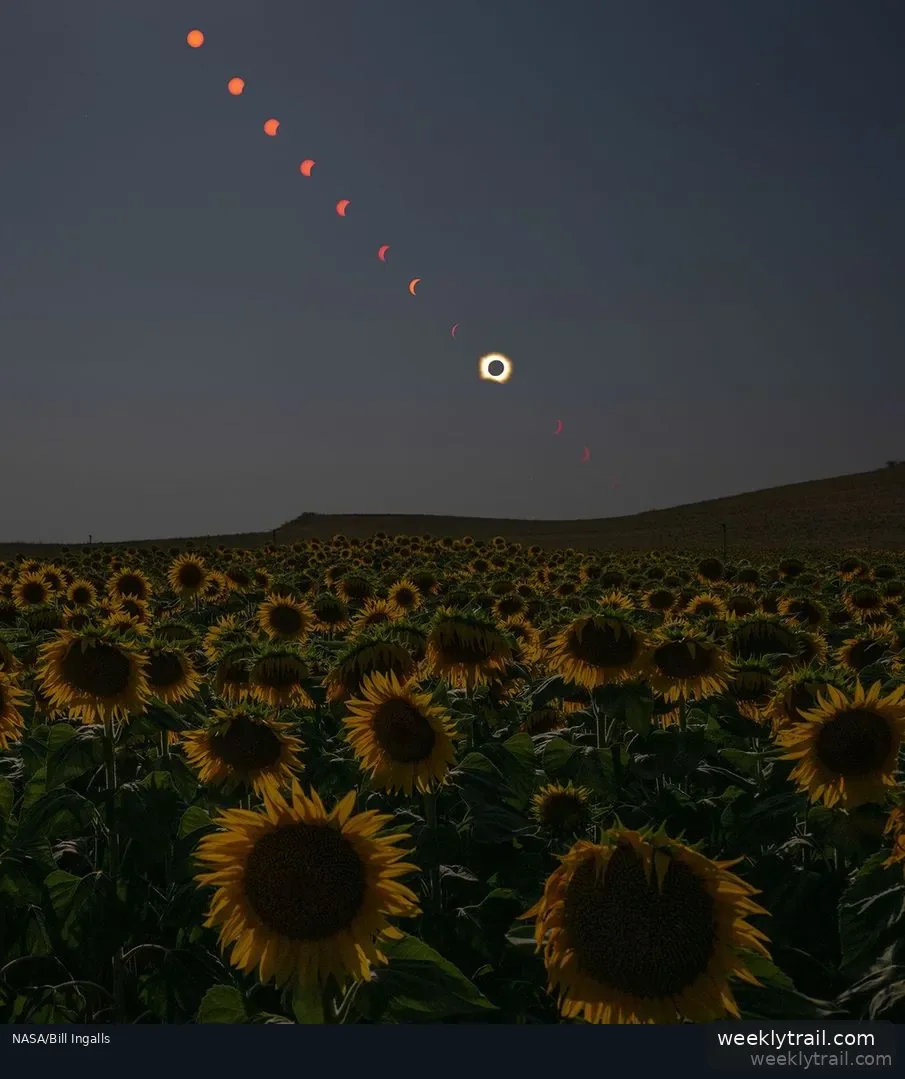
NASA reported on Aug. 21, 2026, that a total solar eclipse darkened skies over Greenland, Iceland and Spain on Aug. 12, 2026, briefly revealing the Sun's corona to viewers along the path of totality who had clear skies. A NASA photographer in San Millán de los Caballeros, Spain, captured the total phase and the partial phases before and after, until the Sun set. A science team led by the Southwest Research Institute in Boulder, Colorado, will analyze images taken in several wavelengths by cameras on NASA's WB-57F research jet, which flew at an altitude of 50,000 feet off Iceland to lengthen its time in the eclipse's shadow.
In northern Maine, where only a partial eclipse was visible, a NASA photographer captured the International Space Station transiting the partially eclipsed Sun at roughly five miles per second, with a crew of seven aboard Expedition 75. From the station, 262 miles above southern Quebec, NASA astronaut Jessica Meir photographed the partial eclipse; NASA said the Moon covered about 18% of the Sun at the peak from that vantage.
In Iceland and Spain, student teams in the NASA-funded Nationwide Eclipse Ballooning Project launched scientific balloons to study effects on the atmosphere, NASA said, adding that clouds over Iceland did not prevent the instruments from gathering data. Scientists at Predictive Science Inc., supported by NASA grants, compared a corona prediction made on the morning of Aug. 12 with a composite image captured near León, Spain. NASA said researchers will analyze the observations over coming months and use them to prepare for a longer total solar eclipse expected to be visible from southern Spain and northern Africa on Aug. 2, 2027.


No comments yet.