 WeeklyTrail
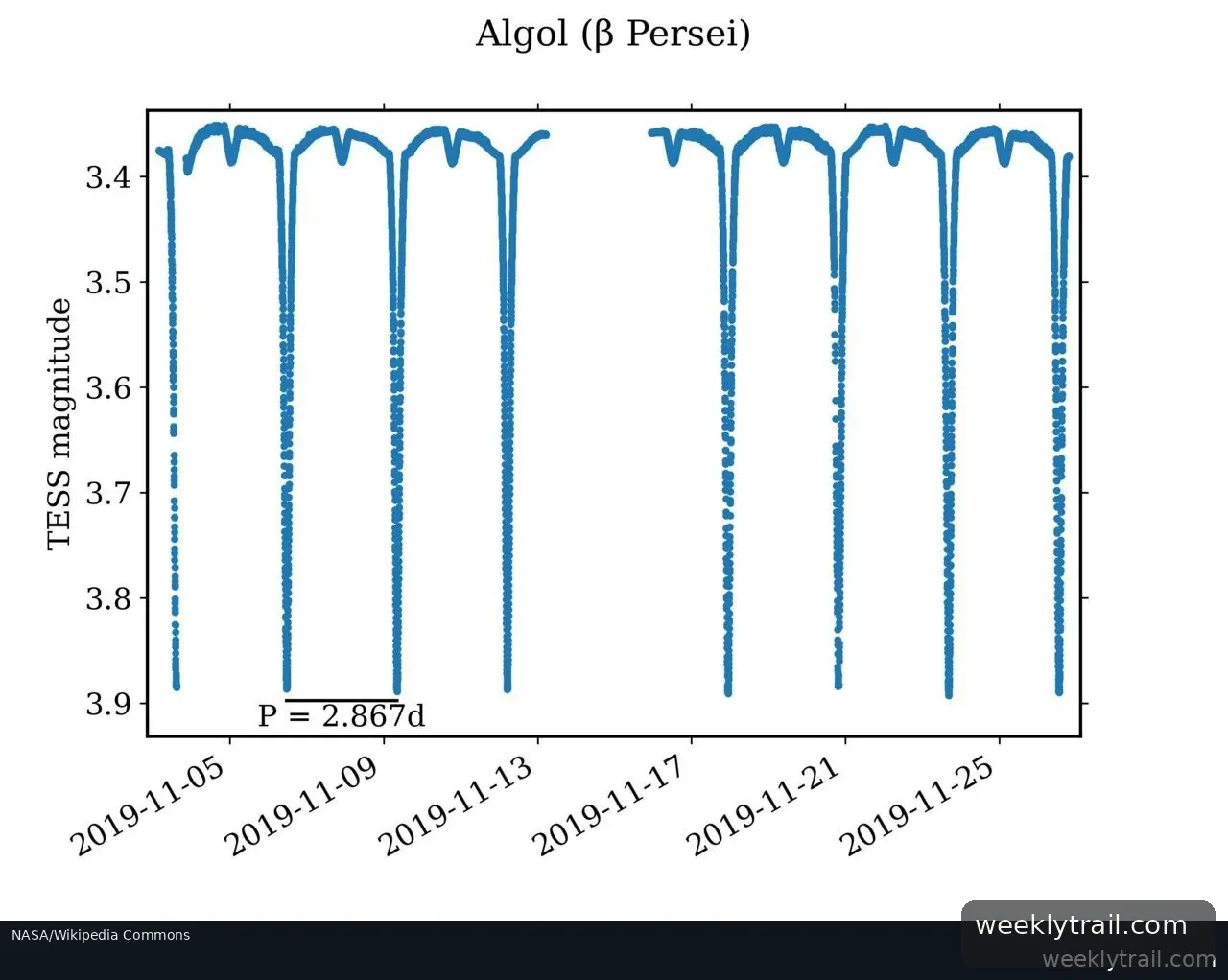
NASA's October night sky notes, published September 28, 2026, highlight two celestial objects with Halloween-themed nicknames. The first is Algol, a star in the constellation Perseus also called the "Demon Star" or "The Ghoul," which can be spotted in the northeastern sky after 9 PM alongside Cassiopeia and Andromeda during the autumn months.
Algol is a triple-star system in which two stars eclipse one another, causing its brightness to drop from magnitude +2.1 to +3.4 roughly every three days. The article notes that observers can compare Algol's brightness with the nearby star Almach in Andromeda using binoculars or a small telescope. A light curve from NASA's TESS mission illustrates the regular dimming.
The second object is IC 2118, the Witch Head Nebula, a reflection nebula about 900 light-years away between the constellations Eridanus and Orion, illuminated by the star Rigel. Because it depends on nearby starlight, it is not visible to the naked eye; the article says very large-aperture, low-magnification telescopes under dark skies make it easier to see, and astrophotographers may capture it within a few hours depending on equipment and sky conditions. The piece also points readers to the Witch's Broom in the Western Veil Nebula in Cygnus.

Start the conversation. A good question is half the story.