 WeeklyTrail
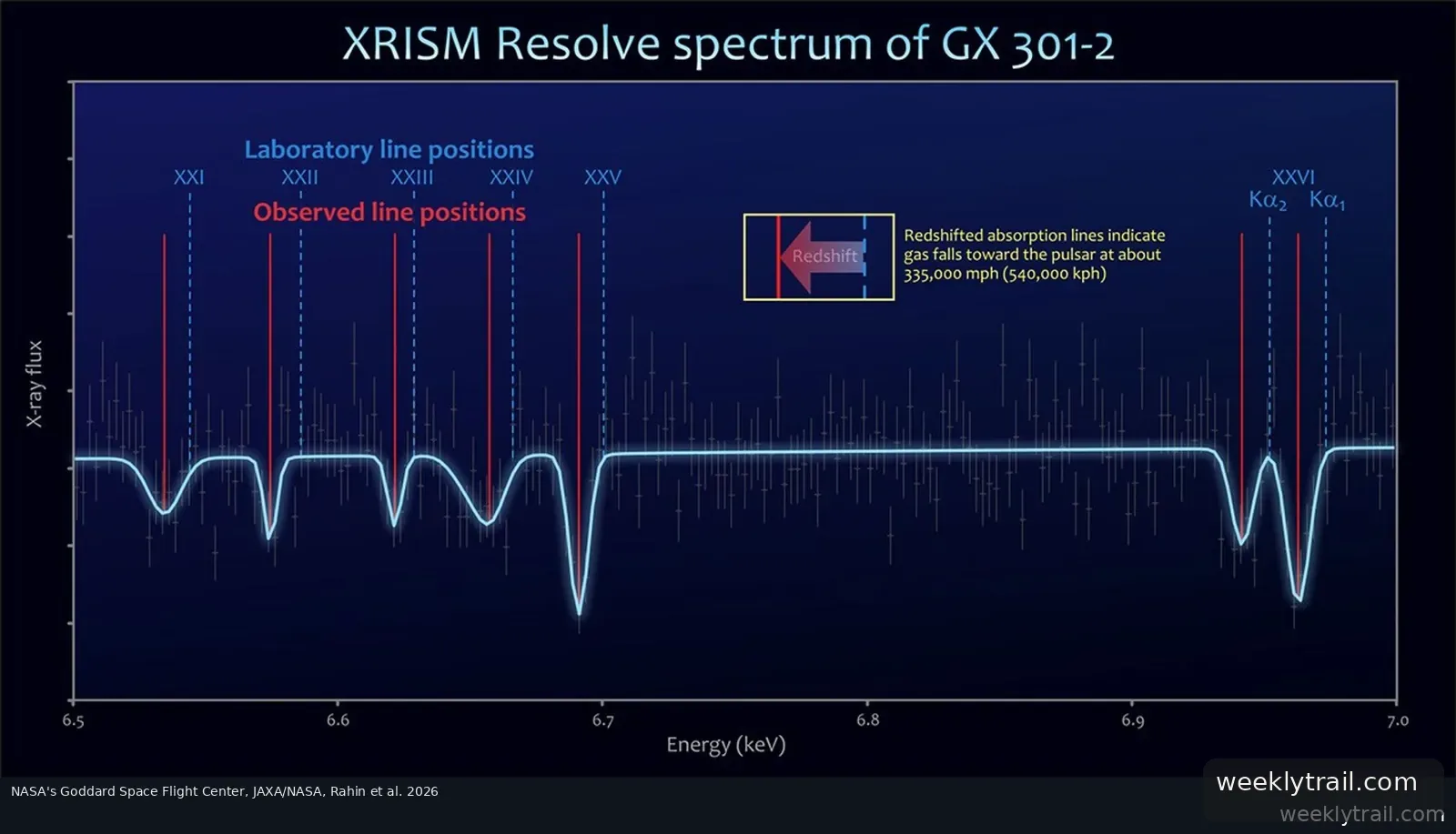
NASA and Japan's JAXA space agency reported on Sept. 18, 2026, that data from the XRISM observatory showed a giant star's outflow being captured by its compact companion, powering strong X-ray flares. The findings were published that day in Science Advances. The system, BP Crucis, lies about 13,000 light-years away in the southern constellation Crux.
The primary star, Wray 977, is a blue hypergiant about 40 times the Sun's mass and 60 times its size, streaming ionized gas as a stellar wind. Its companion, GX 301-2, is a neutron star roughly 12 miles (20 kilometers) across that rotates every 11 minutes and sweeps an X-ray beam toward Earth. Flares occur twice during the pulsar's 41.5-day orbit as it passes through a dense plasma stream. XRISM observed the system for about 16 hours on Feb. 1, 2025. Iron absorption lines indicated gas moving toward the pulsar at about 335,000 mph (540,000 kph).
The team proposed that the pulsar sweeps gas into a turbulent disk that powers flares, then breaks down so plasma falls directly onto the star. Researchers said they had not previously seen clear signs of wind plasma falling onto a compact object. The transit takes about four days.



Start the conversation. A good question is half the story.