 WeeklyTrail
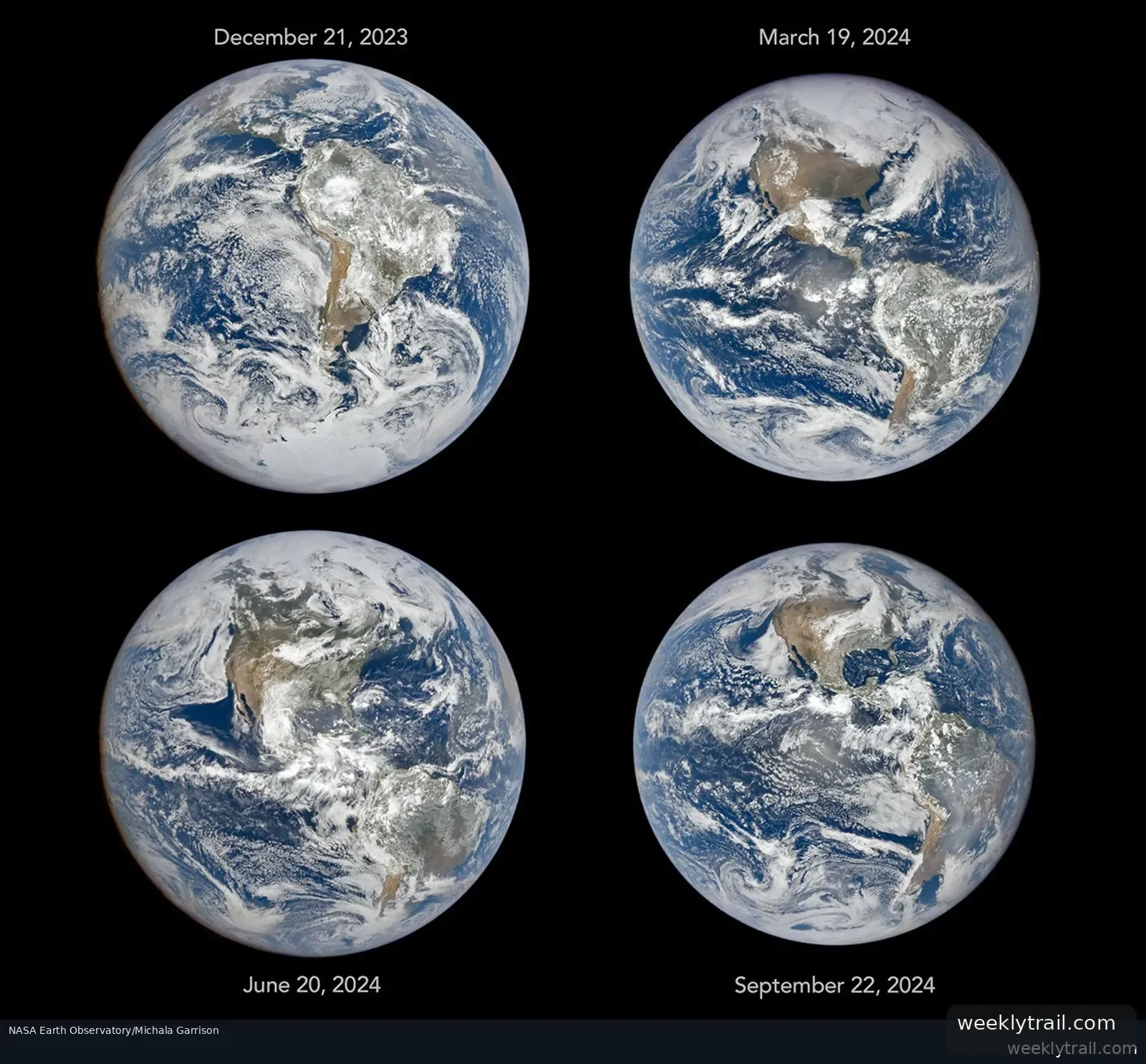
NASA Earth Observatory reported on September 22, 2026, on images from the EPIC (Earth Polychromatic Imaging Camera) aboard the NOAA DSCOVR mission that illustrate how Earth's roughly 23.5-degree axial tilt changes the apparent position of continents across the seasons. The four images were taken at the December solstice, March equinox, June solstice and September equinox, at roughly the same time of day.
The sharpest contrast is between the solstices. In the December image, South America sits near the center of the disk and much of Antarctica is visible, while North America is partly out of view. In June, the Northern Hemisphere and North America are more centered, Arctic sea ice appears and Antarctica is out of view.
Earth also looks slightly smaller at the equinoxes because DSCOVR's Lissajous orbit changes its distance. The observatory reported that DSCOVR was 1,447,327 kilometers from Earth on December 21, 2023, versus 1,561,901 kilometers on September 22, 2024. Deputy project scientist Alexander Marshak said the most obvious changes are due to Earth's tilt.



No comments yet.