 WeeklyTrail
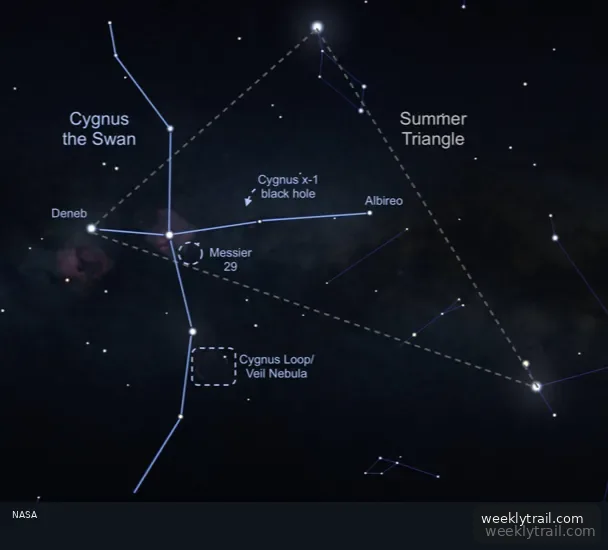
A NASA night-sky article published Aug. 15, 2026 describes how to find the constellation Cygnus, the swan, starting from Deneb, the northeasternmost and dimmest star of the Summer Triangle. The piece, updated by Kat Troche from an earlier version by Dave Prosper, notes that Cygnus is visible in the Northern Hemisphere through the summer.
The article points readers to viewing targets including the Veil Nebula, a supernova remnant that appears as a faint ring of illuminated gas about three degrees across, roughly six times the Moon's diameter. It also covers the X-ray source Cygnus X-1, discovered in 1971 during a rocket flight and described as the first X-ray source widely accepted as a black hole. According to the report, it has a mass of about 20 Suns, spins more than 800 times a second while pulling matter from a companion star, and lies 6,070 light years away, posing no threat to Earth.

No comments yet.