 WeeklyTrail
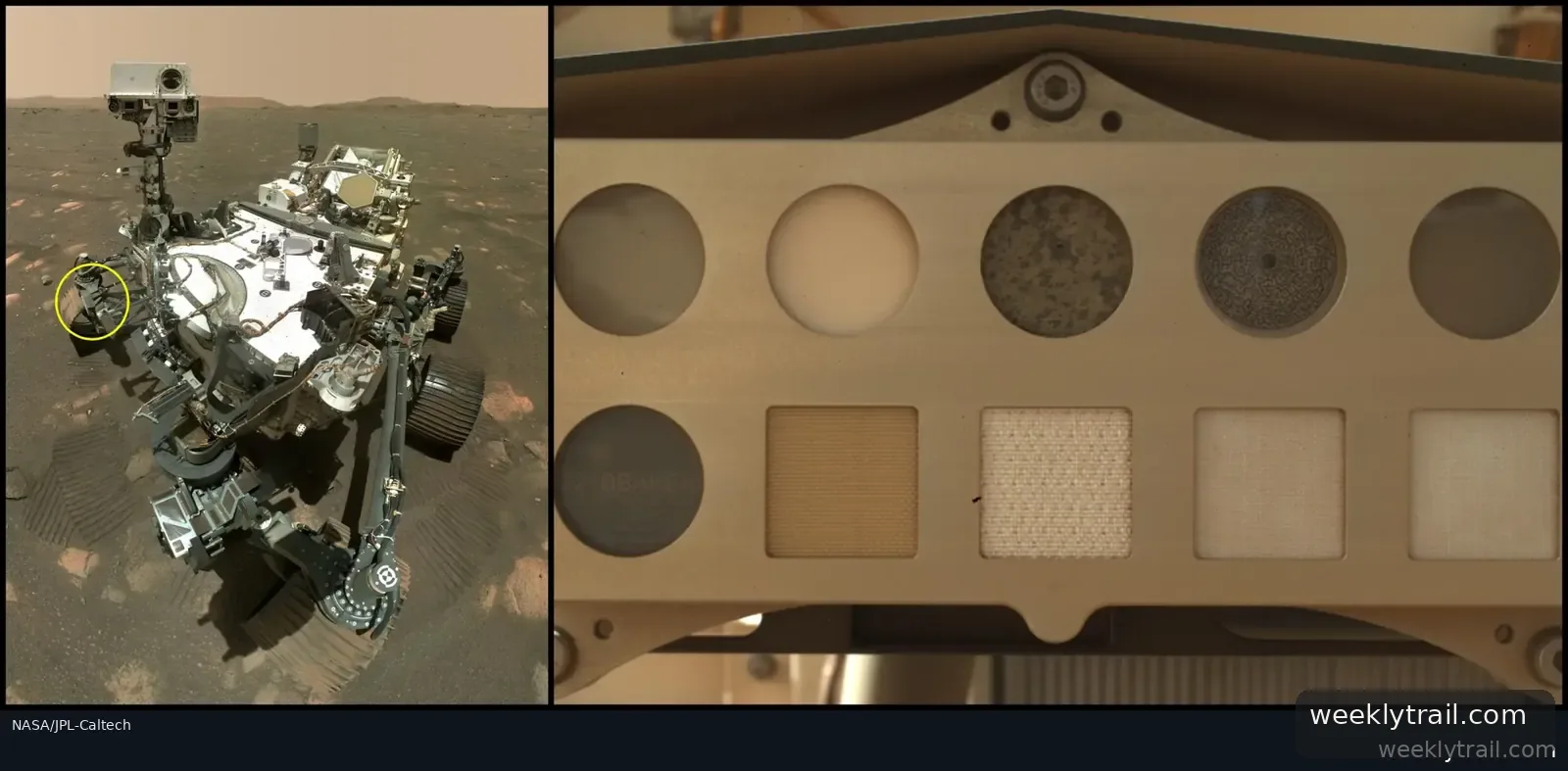
NASA's Perseverance rover has measured fine and ultrafine dust particles on Mars, including grains small enough to penetrate the lungs and enter the bloodstream, the agency said in an article published Oct. 26, 2026. Results from more than 1,645 Martian days of observations were set to appear Tuesday, Oct. 27, in the Proceedings of the National Academy of Sciences.
The rover carries five three-quarters-inch (20-millimeter) square swatches of spacesuit material as part of a calibration target for the SHERLOC instrument. The PIXL instrument's target carries Teflon and basaltic glass; because Teflon contains no elements PIXL can detect, dust signals from that sample come from particles resting on it. PIXL detected fine particles under 2.5 micrometers and ultrafine particles around 100 nanometers, compared with an earlier resolution limit of about 3 micrometers.
Static electricity appears to govern which particle sizes stick to which surfaces, and the finest grains remained attached through years of driving and drilling. The dust matched the iron- and sulfur-rich composition seen by earlier missions, with added phosphorus and signs of calcium sulfate. NASA said the findings could guide spacesuit and habitat materials, dust-removal procedures and crew health standards; prior work includes an Electrodynamic Dust Shield tested on the Moon in March 2025.


Start the conversation. A good question is half the story.