 WeeklyTrail
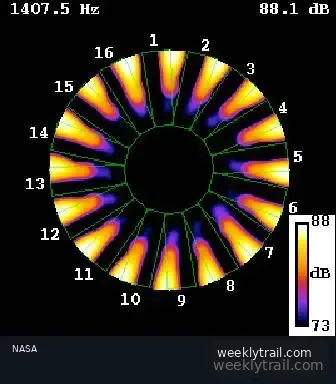
NASA Glenn Research Center relies on specialized instrumentation—including particle image velocimetry, hot wire anemometry, Raman spectroscopy, microphones in phased arrays and continuously rotating rakes—to measure airflow and sound, according to a page published October 19, 2026. The center says the global aviation noise reduction community uses data from its experiments to validate theory and noise prediction software.
The rotating rake mode measurement system addresses tones from turbofan engines. NASA Glenn engineers pioneered procedures using rotating microphones in the 1990s, since stationary microphones cannot capture the tones' modal content. The rakes have been used in low-speed proof-of-concept tests on the Advanced Noise Control Fan Rig and the 9- by 15-Foot Low Speed Wind Tunnel, as well as in full-scale turbofan engine ground tests.
In phased arrays, microphones are arranged in one, two or three dimensions, and processed measurements can pinpoint noise sources. NASA Glenn's Array48 system has been used on scale-model jet flows, a counter-rotating open rotor fan model and a full-scale F404 military engine. Separately, hot wire probes and laser Doppler velocimeters measure air velocity upstream, downstream and between rotor and stator, and the data are routinely used to validate turbofan noise estimates.

Start the conversation. A good question is half the story.